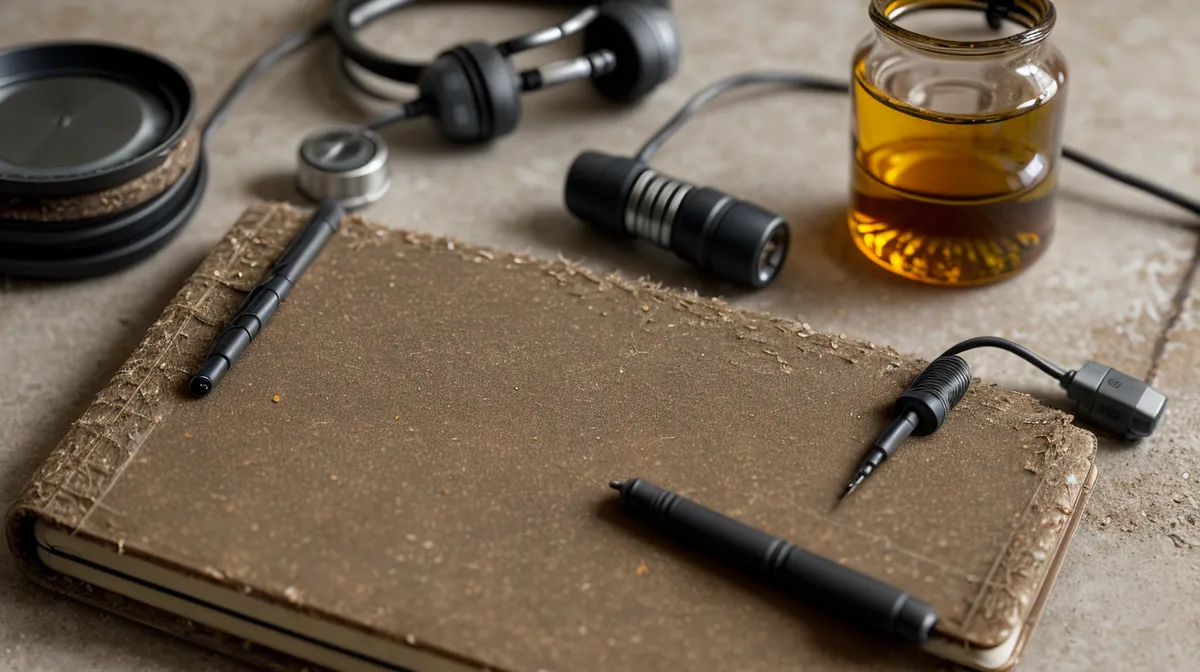
A packed club used to leave my ears a little tired and fine by morning; a dead-quiet bedroom now leaves them screaming until sunrise. That swap is the whole story nobody warned me about. I spent a long career in audio engineering — line arrays, conference-room AV installs, the lot — and never once treated hearing protection as part of the gig. These days I run a tinnitus-testing routine the way I used to commission a PA, and the supplement log on my desk is thicker than any work ticket I ever closed. What follows is the safety protocol I'd hand my younger self, written as a checklist instead of a long apology.
My wife says I'm more obsessive about this ringing than I ever was about actual work orders, and she's not wrong. I'm no doctor and no audiologist — just the tech who could always find the hum in a ground loop and somehow never thought to shield his own sensors. The short version of everything below: protection has to be in place before the noise starts, because not one part of this system is refundable. There's the irony I live with daily: the guy whose entire job was clean signal now walks into every room carrying the loudest noise floor in it.
Number One: Your Ears Ship Without a Spare Part
In live sound and IT, we're trained to think in modules. A blown high-frequency driver gets a fresh diaphragm before the next set; a dead power supply gets swapped and forgotten. Your hearing refuses to play along. The cochlea is one of the only components in your entire signal chain with zero spare parts and no RMA process — when it goes down, it stays down, and there's no firmware rollback waiting for you.
Skip the plugs at one loud gig and nothing seems to happen — that's the trap. The damage doesn't bill you the same night; it quietly files the paperwork. If you'd never run an expensive rig without a limiter, you've got no business running the parts you can't replace without protection. The longer field-level version of how I learned this lives in my audio tech tips for protecting hearing at live music events.

Number Two: Hearing-Protection Latency and the Delayed Bill
Latency, in audio terms, is the delay between an input and the system's reaction — you hit the key and the monitor answers a beat late. Hearing-protection latency is that same gap pointed at your ears: the stretch between the moment loud exposure starts and the moment protection actually goes in. Every second in that gap is unprotected runtime. The fix is boring and total — plugs go in at load-in, not at the first wince — because by the time your ears feel "full" or stuffy, the exposure has already happened.
The second kind of latency is the cruel one. There's a long lag between the damage and the symptom, so the plugs you skip tonight don't charge you tonight. The invoice shows up much later as a tone that never clocks out. That delay is exactly why so many of us ignored protection for so long — no immediate punishment, no obvious cause-and-effect, just a slow erosion of headroom we only noticed once the signal was permanent.
Number Three: Quiet Rooms Ring Louder Than Stages
Here's the part that messes with audio pros specifically. We worship Active Noise Cancellation — it's a gorgeous trick of phase inversion, meeting an incoming wave with its mirror image to manufacture silence. For a set of ears with a high internal noise floor, though, maxing ANC can backfire. When I flip a good pair of cans to full cancellation in a silent room, the tone climbs to fill the vacuum — the brain seems to crank its own gain hunting for something, anything, to listen to, and it lands on the ringing.
Total silence, it turns out, works against you. I'd rather hold a low room-tone floor than chase a dead-silent baseline, so I keep a bit of ambient hiss in the air or run open-back headphones instead of sealing everything off. Give the brain even a faint real signal and it stops amplifying the phantom one. The decision rule is simple: never hand a high-gain tinnitus signal a perfectly empty room to perform in.

Number Four: Mapping Your Own Frequency Like an RTA Sweep
On a live system, I'd reach for a real-time analyzer to see exactly where a room peaks and nulls before touching an EQ. You can do the same to your own head with a cheap frequency generator. Occupational noise-induced tinnitus most commonly lands in the 3,000–8,000 Hz range — the stretch of the cochlea that takes the worst beating from sustained high-level noise — and mine sits high and narrow, right up where cymbals and sibilance live. Delroy, another audio tech I trade notes with, runs his sweep too; his tone parks a hair below mine, which tells us both nothing useful and somehow makes the whole thing easier to carry.
Knowing your band changes how you talk to professionals. Instead of telling an audiologist "it sounds like a bell," you can describe a narrow, high-frequency signal and let them work with a spec instead of a vibe. It also tells you where to set a masker on a rough day — a notch of sound near your tone to give your brain an easier target. I'm still sorting out whether to stack or rotate the bottles I'm testing, which is half of why I keep comparing ZenCortex and Zeneara for managing constant ear ringing.
Number Five: Run Protection as a Spec, Not a Macho Test
There's an old-school machismo in the Nashville scene — and everywhere else — about not needing earplugs, as if hearing the mix raw makes you tougher. You know what colors a mix more than a flat filter? Permanent nerve damage. Lose the top end and you start over-cranking the high shelf to chase sizzle that isn't there anymore, and suddenly your mixes sound like icepicks to everyone whose sensors still work.
Flat, high-fidelity filters — the kind that pull the level down evenly without smearing the transients — would have made me a better tech, not a softer one. They'd have kept my ears fresh for the end of the night, when the real mixing calls happen, instead of fried by the second act. If you're still in the game, my guide on how to choose professional earplugs for musicians and live sound techs walks through picking filters that protect without lying to your ears.

Most of that desk notebook is plain troubleshooting — trigger identification, really: what I ate, how I slept, when the tone climbed and what was different that day. I run each new bottle through the same testing protocol, one variable at a time, with a washout stretch between them so I'm never reading two signals at once. The honest result so far is a long column of small nothings. A month of magnesium glycinate before bed nudged my sleep up a notch and left the tone exactly where it was — sleep win, ringing loss, logged and moved on.
Lamont — an old colleague from the touring circuit — forwards me other people's tinnitus articles with zero commentary, just a bare link sitting in the thread like evidence he expects me to file. I read them, then go back to the whiteboard on my closet door where the cycles live, next to the foam panels I scavenged off a decommissioned conference room. One night the phone lit up in a pitch-black room and the tone didn't jump to meet the glare — a small thing, but it went straight into the notebook. That's the job now: the audio guy who wrecked his own hearing, still chasing a clean signal-to-noise ratio, still wishing he'd put the plugs in first. Keep your levels in the green, and wear the earplugs you keep telling everyone else to buy.
This site is for informational and entertainment purposes only. I am not a licensed healthcare provider, financial advisor, or attorney. Seek professional counsel before making any health or financial decisions.
This site is for informational and entertainment purposes only. I am not a licensed healthcare provider, financial advisor, or attorney. Seek professional counsel before making any health or financial decisions.