
A hearing aid works on the sound going into your ears; a tinnitus supplement is something I take for the sound my ears make with no input at all, and those are not the same repair job. Most of my tinnitus management runs on that second signal: an audio tech, not a doctor, troubleshooting his own hearing health the way he'd chase a dead channel on a console. Which is why I lean on supplement testing, not another trip to the hearing-aid counter.
Quick disclosure before I open up the signal chain — some of the links below are affiliate links, so I earn a commission if you buy through them (at no extra cost to you). Products like Audifort only come up because I've logged their effects in my own notebooks for months, and I'll say it plainly: I'm the audio guy who mixed other people's shows for a living and never once protected his own ears, so treat this as a field report and talk to a real medical professional before you try anything.
Hearing Health Is a Two-Signal Problem
Picture a mixing board with two faders. One fader is the input — how much of the outside world reaches you, and how clearly it lands. The other is the noise floor — the hiss a system makes on its own when nothing is even plugged in (every piece of gear has one; so, it turns out, does a damaged ear). A hearing aid only rides the first fader. Nothing I swallow ever touches it. The supplements I keep bothering to test are aimed squarely at the second fader — the internal hiss that can make a silent bedroom the loudest place I know.
Getting that split straight is the first thing I'd hand anyone weighing the two, because it saves a lot of wasted money. If your real complaint is that voices go muddy across a dinner table, that's an input problem, and a device is the honest answer. If your complaint is a high tone that screams in a quiet room, no amount of amplification is going to reach into your skull and mute it. Different fader, different tool.
What Does a Hearing Aid Actually Fix?
The device route treats your ears like damaged gear that just needs better outboard equipment, and for a while that logic had me completely. The theory is sound — literally. You boost the frequencies you've lost so the brain has something real to lock onto, the way you'd raise a weak channel until it sits back in the mix. For a guy who built a career around a clean sampling rate and high-fidelity gear, though, the payoff was maddening: a good aid amplifies the world beautifully and still doesn't lay a finger on the ghost in the machine.
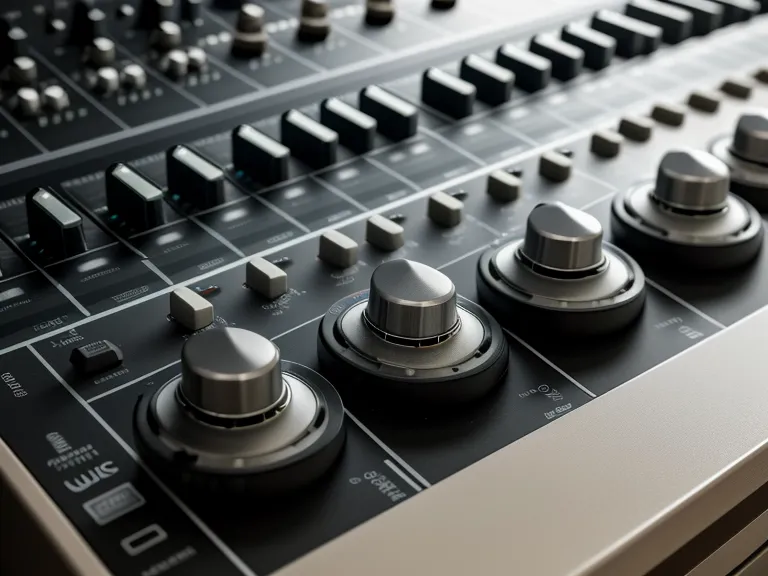
A hearing aid is built to improve speech intelligibility, which is great if the problem is hearing. But push a wide-band boost into a room full of stage wash — the kind that hangs in the green-room corridor at the Ryman between sets — and you don't get relief, you get a louder version of the exact thing that sets the ringing off. It's turning up the gain on a noisy channel: the signal comes up, sure, but so does everything you didn't want, right to the edge of redlining.
There's a hard ceiling built into all of this. A healthy ear covers the whole human hearing frequency range, and the top octave — the sparkle, the air — is the first thing to go when you've stood in front of enough loud rigs. Once those high-end drivers are blown, no device rebuilds them; it can only borrow from what's left. That's the wall I keep bumping into: you can shape the input all day and still not manufacture detail that isn't there anymore.
The part that trips every engineer instinct I've got: you cannot phase-cancel a signal that isn't in the air. Noise cancellation works by playing a sound's mirror image against it, and my tinnitus has no waveform out in the room to mirror — it's generated downstream of the mic, so to speak. That's the whole reason clever processing in a hearing aid was never going to zero it out.
Where Supplement Testing Comes In
Once the input side is handled — or, in my case, once I accepted the input side had a ceiling — the only fader left to experiment with is the internal noise floor. That's why I started treating supplements like scheduled maintenance for the gear that's left, rather than a cure. Audifort has been my main test case for a while now, mostly because the ingredient list read like something aimed at general hearing support (not the usual miracle pitch), and that's the kind of label I'm willing to run through my own logs.
That doesn't make it a fix, and I won't pretend my notebook proves anything a lab would sign off on. What I can say is that I run it like any change to a system: one variable at a time, the same measurements every day. If you want the granular version of what I check on a label, I broke it down in my Audifort Ingredients Review from a sound tech perspective.
Plenty of approaches never earned a spot in that kit. I gave the Tibetan singing-bowl videos on YouTube an honest run as a sound-therapy fix, and I dropped them — my brain treated the bowls as one more signal to analyze instead of something soothing, so the ringing just had company. That's the thing about troubleshooting by elimination: the failures are data too, and that one told me plainly that passive masking with prettier sounds wasn't my lane.
The reason I bother with maintenance at all is that sound damage has no undo button. A career's worth of standing next to levels well past 85 decibels without a single pair of earplugs doesn't reverse. When the input finally thins out, the brain does something almost predictable to anyone who's worked a console: it cranks the gain on a channel that's gone quiet and hands you a wall of static instead of silence. My high tone is just that auto-gain, stuck wide open.
Reading the Logs — How I Judge Whether Anything Works
Here's the method, because it's the only part of this worth copying. I never test two new things at once — stack two supplements, or change my sleep habits and a formula together, and I've lost any way to tell which fader actually moved. One change, held long enough to mean something, logged against the same rough severity scale every single day. That's how I keep troubleshooting the ringing honest instead of just hoping something helps.
The logs catch the good days too, which are easy to miss when you're braced for the worst. One evening I killed the engine in the driveway and caught myself not tensing up for the tone to come rushing into the quiet — a small thing, but those go in the notebook the same as the bad nights. When a run plateaus, I'll occasionally rotate in an alternative like Quietum Plus to see whether my ears react differently to a different balance of ingredients, then log it identically. Same test, different unit under the microscope.
None of this is a case for skipping the professionals — get the hearing checked, get the input measured, have the device conversation properly. My argument is narrower: the internal noise floor is a separate job a device won't finish, and it's the job I can actually run experiments on. For the routine I use to keep the tone from peaking after dark, there's my nightly tinnitus protocol here, and Audifort has stayed in the kit because, so far, it's the one I keep choosing to log rather than replace.
This site is for informational and entertainment purposes only. I am not a licensed healthcare provider, financial advisor, or attorney. Seek professional counsel before making any health or financial decisions.