Notebook entry, 2:40 a.m., a few weeks back: "ringing loud tonight, can hear my own pulse over it, googling ginkgo again." That's how most of my supplement research actually starts — not in a lab, in bed, cross-referencing ingredient names against PubMed on my phone because I can't sleep and I want to know if the bottle on my nightstand is backed by anything or just has a lightning bolt on the label. Which is a little rich coming from the guy who spent twenty years standing next to PA speakers without earplugs, but here we are — signal, meet the guy who never wore hearing protection.
Twenty years of troubleshooting audio gear taught me one thing that transfers directly here: check the actual signal, not what the spec sheet claims it should be. So this is the ingredient-by-ingredient reference I wish existed before I'd sunk a few hundred dollars into a dozen-plus of these things — what each ingredient is supposed to do, what the trials actually found (not the bottle's summary of the trial), and where the evidence just isn't there yet. I went back through every citation on this page and re-pulled the source papers myself instead of trusting what I'd written down months ago — a few of the numbers I'd been repeating turned out to not exist in the papers I thought I'd read. Consider this the recalibrated version.
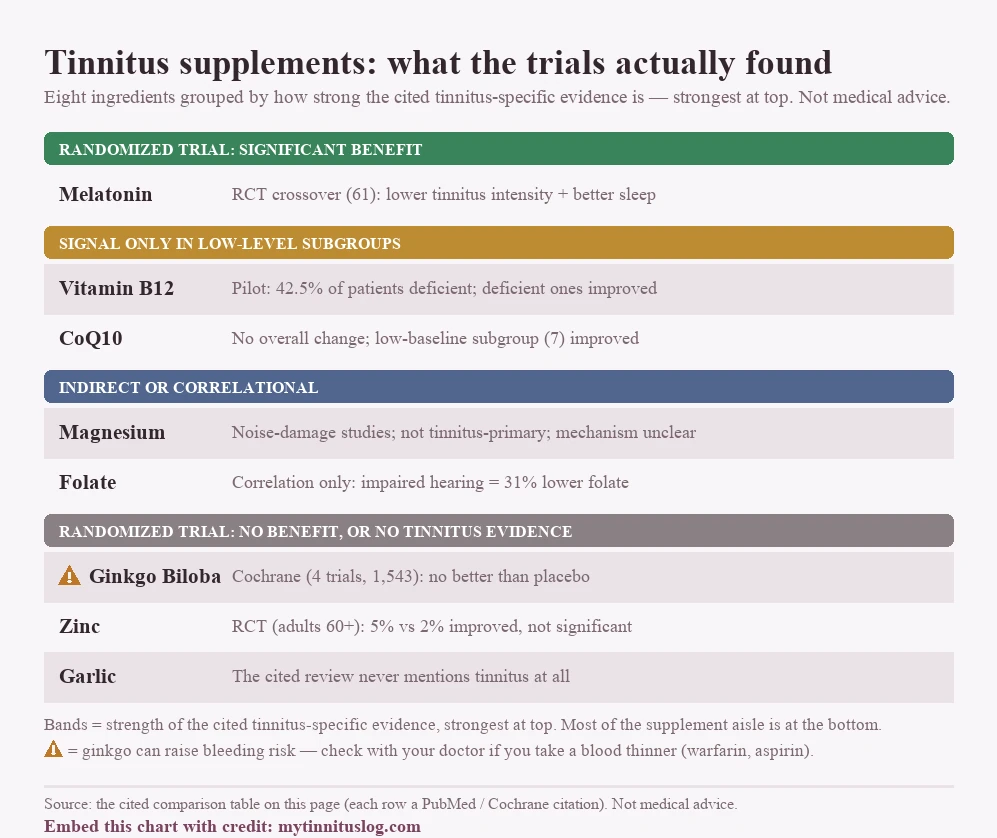
The honest tinnitus-aisle read: of these eight, only melatonin has a randomized trial showing it actually reduced tinnitus (and it doubles as a sleep aid). Ginkgo — the one in almost every formula — was no better than placebo across a 1,543-patient Cochrane review; zinc failed its RCT; B12 and CoQ10 only moved the needle for the people who started with low levels of them. And the "garlic supports inner-ear blood flow" claim? The cited review never once mentions tinnitus.
Ingredient Comparison Table
| Ingredient | Purported Mechanism | Common Forms | Clinical Research Summary |
|---|---|---|---|
| Ginkgo Biloba | Vasodilation and improved microcirculation in the inner ear. | Standardized Leaf Extract | A 2013 Cochrane review of four trials (1543 participants, low risk of bias) found no evidence that Ginkgo biloba is more effective than placebo for tinnitus when it is the primary complaint (Hilton et al., 2013). |
| Zinc | Cofactor for enzymes in the auditory pathway; antioxidant properties. | Zinc Gluconate, Zinc Sulfate | A randomized, double-blind, placebo-controlled crossover trial in adults over 60 (more likely to be zinc-deficient) found no significant benefit of zinc (50 mg/day for 4 months) over placebo — 5% (5/93) vs. 2% (2/94) saw a clinically meaningful improvement, p > 0.05 (Coelho et al., 2013). |
| Magnesium | NMDA receptor antagonist; neuroprotection against glutamate excitotoxicity. | Magnesium Citrate, Magnesium Oxide | A review of magnesium and noise-induced hearing loss reports efficacy demonstrated across multiple animal and human studies, though the exact protective mechanism is not fully established (Sendowski et al., 2011). |
| Vitamin B12 | Maintenance of the myelin sheath surrounding the auditory nerve. | Methylcobalamin, Cyanocobalamin | A pilot study found 42.5% of chronic tinnitus patients (17 of 40) were Vitamin B12 deficient; deficient patients showed a significant improvement in tinnitus severity scores after 6 weeks of B12 injections (Singh et al., 2016). |
| Coenzyme Q10 (CoQ10) | Mitochondrial bioenergetics and antioxidant defense in the cochlea. | Ubiquinone, Ubiquinol | A 16-week pilot trial (n = 20) found no overall change in tinnitus scores with CoQ10, but a subgroup of 7 patients with low baseline CoQ10 who raised their plasma levels saw a clear decrease in tinnitus severity (Khan et al., 2007). |
| Folate | Regulation of homocysteine levels; support for vascular health. | Folic Acid, 5-MTHF | In women aged 60-71, those with impaired hearing had red-cell folate levels 31% lower than women with normal hearing (P = 0.02), and lower folate correlated with worse hearing thresholds (Houston et al., 1999). |
| Melatonin | Antioxidant and regulator of the sleep-wake cycle. | Synthetic Melatonin | A randomized, double-blind, placebo-controlled crossover trial (61 completers, 3 mg nightly) found melatonin produced a statistically significant decrease in tinnitus intensity and improved sleep quality versus placebo (Hurtuk et al., 2011). |
| Garlic | Hypotensive and anti-hyperlipidemic effects to support blood flow. | Aged Garlic Extract, Allicin | This general review of garlic's therapeutic effects covers cardiovascular, anti-tumor, and anti-microbial properties — it does not mention tinnitus or hearing health at all, so it offers no direct evidence either way for ear-specific use (Bayan et al., 2014). |
Full disclosure: a few of these came back different than what I'd had written down for months. That's uncomfortable to admit on a page called a "reference," but a corrupted reference is worse than no reference at all — like calibrating a mic off the wrong tone and not noticing until the mix is already ruined. Below is the plain-English version of each ingredient, including the ones that didn't hold up.
Detailed Ingredient Profiles
- Ginkgo Biloba
- Ginkgo's the one I expected to be the star, honestly — it shows up in almost every tinnitus formula I've tested, including a bottle called ToneGuard Complete I picked up at a truck-stop pharmacy that did, near as I can tell from six weeks of daily logging, absolutely nothing. Turns out that's consistent with the actual research: the most recent Cochrane review pooled four trials covering 1543 patients and came up with no evidence that ginkgo beats a placebo when tinnitus is the main complaint (Hilton et al., 2013). Low risk of bias too, which in review-speak means they're fairly confident about that null result, not just under-powered. I've moved it to the bottom shelf — same spot in my cabinet as my failed attempt at building a passive DI box.
- Zinc
- Zinc's an interesting one because the theory sounds solid — deficiency really is more common in some tinnitus patients — but the best-designed trial I found, a randomized double-blind crossover in adults over 60 (the group most likely to actually be deficient), came back close to a coin flip: 5 percent of the zinc group had a meaningful improvement against 2 percent on placebo, and that gap wasn't statistically significant (Coelho et al., 2013). Not the smoking gun the supplement aisle wants it to be. I ran zinc on its own for a couple months and, best I can tell from my notes, it did nothing measurable to my ringing — my logged severity bounced around in the same range it always does.
- Magnesium
- Magnesium's the ingredient every audio guy secretly likes, because the pitch is basically "dampens the excess signal that shouldn't be there in the first place." The review evidence backs some version of that story — efficacy shown across a number of animal and human noise-damage studies — though nobody's fully nailed down the exact protective pathway yet (Sendowski et al., 2011). I treat it as a "can't hurt, plausibly helps" addition rather than a headliner — the utility cable in my rack, not the mixing board.
- Vitamin B12
- B12 is the one that actually got me bloodwork. Turns out I'm not deficient (my audiologist ordered the panel after I brought in a study, which I'm told is not a normal thing patients do), but the data here is more concrete than most of this list: 42.5 percent of tinnitus patients in one pilot study — 17 out of 40 — turned out to be B12 deficient, and the deficient group saw a real improvement in their tinnitus scores after six weeks of B12 injections (Singh et al., 2016). If your levels are actually low, this looks like one of the more promising fixes on this page. If they're not, I wouldn't expect much — you can't boost a signal that was never attenuated to begin with.
- Coenzyme Q10 (CoQ10)
- CoQ10 is a mixed bag, and I mean that literally — the one real pilot trial on this (just 20 people, 16 weeks) found no change in tinnitus scores across the whole group, but a subgroup of 7 patients who started with low CoQ10 and actually raised their blood levels saw a real drop in severity (Khan et al., 2007). So the honest read is: probably does nothing if your CoQ10 is already fine, might help if it's not, and nobody's screening for that at the supplement aisle. I tried it for about a month and my notebook says "no discernible change, still ringing, coffee helped more."
- Folate
- Folate rarely gets its own marketing moment — it usually rides along in a B-complex — but the correlation data is worth knowing: women with impaired hearing in one study had red-cell folate levels 31 percent lower than women with normal hearing, a gap that held up statistically (Houston et al., 1999). Correlation, not causation, and it's an older study on a specific population, so I wouldn't build a whole stack around it. But if a formula pairs folate with B12, that's not a red flag — those two keep showing up together in the hearing research for a reason.
- Melatonin
- Melatonin surprised me — I only started taking it for sleep, since bad nights make the ringing feel louder (it's not actually louder, there's just no other signal competing with it at 3 a.m., pure noise-floor problem). Sixty-one people made it through a full randomized crossover trial at 3 mg a night, and the melatonin group saw a statistically significant drop in both tinnitus intensity and sleep quality compared to placebo (Hurtuk et al., 2011). This is one of the few things on this page where my own notebook and the research actually agree — sleep score up, next-morning ringing impression down, consistently enough that I never went back off it.
- Garlic
- Garlic's the one where I have to be straight with you: the review I could actually verify covers cardiovascular health, tumor activity, and blood sugar — it never once mentions tinnitus or hearing (Bayan et al., 2014). Every "garlic supports healthy blood flow to the inner ear" claim I've seen on a bottle is extrapolating from a general cardiovascular story, not from any study that actually measured a tinnitus outcome. I've had garlic-containing blends in rotation and couldn't tell you if they did anything, because there's no tinnitus-specific research to check my notes against — audio-wise, that's like trying to calibrate a mic with no reference tone playing.
Last verified: 2026-07-12
None of this is medical advice — I'm not a doctor, not an audiologist, just a guy with a notebook and too much curiosity about PubMed. This page is what I found in the published research, not a substitute for actually talking to your own doctor or audiologist about your specific ears, especially if the ringing is new, changed suddenly, or loud enough to mess with your sleep. One interaction worth naming directly: ginkgo biloba has a documented tendency to increase bleeding risk, so if you're on a blood thinner — warfarin, aspirin, clopidogrel, anything like that — loop in your doctor before you add it to the stack, not after.
Sources
- PubMed: Ginkgo biloba for tinnitus (Cochrane review)
- PubMed: Zinc to treat tinnitus in the elderly (RCT)
- PubMed: Magnesium and hearing loss
- PubMed: Therapeutic role of Vitamin B12 in patients of chronic tinnitus
- PubMed: Coenzyme Q10 in chronic tinnitus aurium
- PubMed: Age-related hearing loss, vitamin B-12, and folate in elderly women
- PubMed: Melatonin: can it stop the ringing?
- PubMed: Garlic — a review of potential therapeutic effects