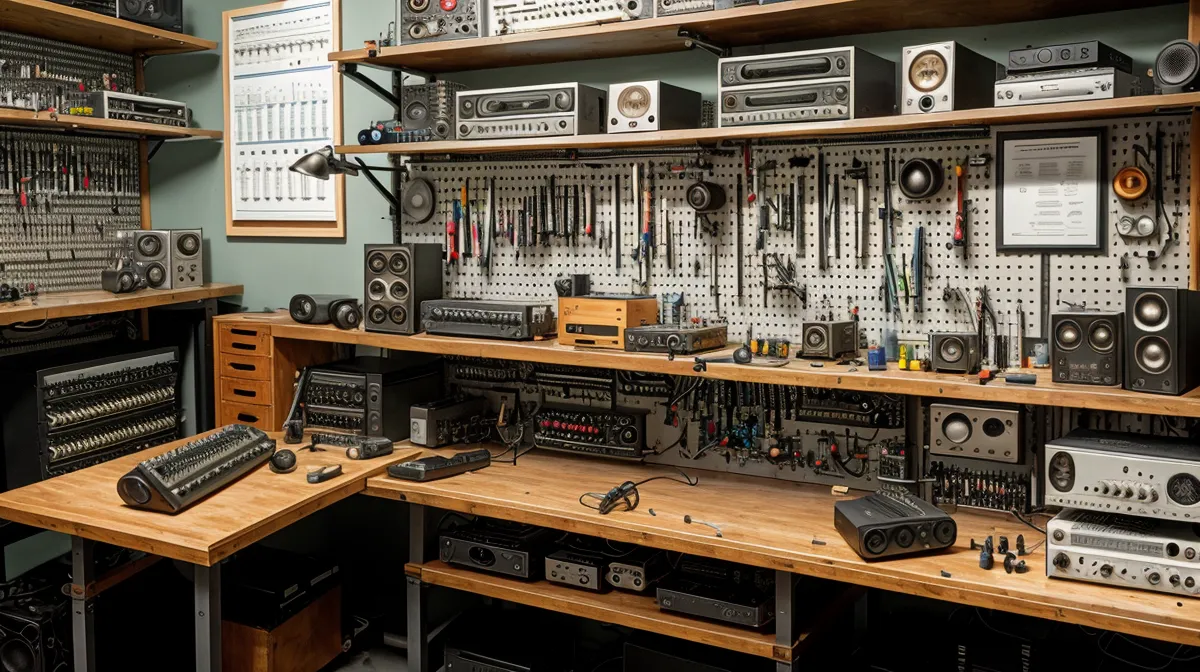
Late at night when suburban Nashville finally settles, my living room doesn't get peaceful. It fills with a piercing whine reminiscent of an old cathode-ray tube television stuck on standby. After twenty years behind live audio consoles without earplugs, I find myself troubleshooting an elusive high-pitched tone that exists solely inside my skull.
Before unpacking my bench notes, a quick word on how I run this site: this site uses affiliate links. If you buy something through these links, I earn a commission at no extra cost to you. I only recommend hearing supplements I have personally tested and tracked in my own notebook. I am an audio technician with stubborn ears, not a physician or audiologist, so please check with a medical professional before starting any new regimen for persistent ear ringing.
If you have ever stared at an audio rack trying to isolate an irritating hum in the mains, you know the basic rule: you do not start turning knobs at random. You map the signal chain. When my tinnitus shifted from an occasional post-gig buzz into a steady high-frequency presence three years ago, my wife caught me pacing the hallway at odd hours, muttering about ground loops. My own auditory system had developed permanent acoustic feedback, and I spent the better part of this year testing whether formulas like Quietum Plus or liquid options like ZenCortex could attenuate the shrill tone keeping me awake.
The Signal Chain: Why High-Frequency Ringing Is Difficult to Tame
In live sound engineering, high frequencies are the most delicate and easily damaged portion of the spectrum. Human hearing spans theoretically from 20 Hz up to the upper boundary of roughly 20000 Hz, but those top octaves take the brunt of every unpadded snare hit and feedback squeal. Decades of standing near monitor wedges without ear protection—because nobody on crew wore them back then and I thought I was invincible—wore down the delicate sensory cells at the base of my cochlea.
That wear almost always shows up in the same spot: the classic acoustic notch right around 4000 Hz. If you run a tone generator at that pitch, it is a sharp, metallic whistle. In my ears, the noise floor does not sound like a gentle waterfall or warm tape hiss; it sounds like a dog whistle oscillating just outside normal conversation. When ambient room noise drops below 30 decibels, the internal gain creeps up automatically.
That is why I began methodically evaluating hearing support formulas. You can explore how I structure my trials in my guide on how to calibrate your tinnitus baseline before testing another supplement. High-pitched feedback requires a different troubleshooting angle than general ear fullness. When I set out to test Quietum Plus against ZenCortex, I wanted to see if either could act as an inline low-pass filter on that piercing 4 kHz edge.
The Bench Setup: Two Different Delivery Mechanisms
I structured my head-to-head comparison to run from late spring 2026 through mid-autumn 2026, giving each product an isolated testing block followed by a clean observation phase. In early June, I lined up the bottles on my desk next to my daily sound log.
The immediate mechanical difference is the delivery method. ZenCortex is a sublingual liquid dropper. The protocol is straightforward: you place a full dropper under your tongue before breakfast, hold it for thirty seconds, and swallow. The taste is herbal with a slightly tart, berry-like finish—not unpleasant, but definitely noticeable. It enters the bloodstream quickly, behaving much like an immediate signal boost.
Quietum Plus, on the other hand, comes in standard capsule form. The label calls for two capsules daily with water. There is no taste to speak of and no routine of standing over the sink with a glass pipette. But that physical distinction points to a deeper functional difference I tracked across my notebook entries: a noticeable trade-off in how the body processes each formula.
Quietum Plus requires a longer continuous usage period to achieve baseline results compared to the faster-acting absorption profile typically observed with ZenCortex. With ZenCortex's liquid suspension, you get a subtle, almost immediate sensation of head clearance within thirty minutes. But for those of us trying to steady a stubborn acoustic loop, speed of absorption does not automatically translate to sustained volume reduction.
Logging the Weeks: Observations from the Daily Sound Log

During the opening month of my trial with ZenCortex, I noted an undeniable bump in mental clarity. As I wrote in my notes on using ZenCortex for brain fog, the mental exhaustion that comes from your brain constantly processing phantom feedback felt dialed down. The liquid formula acted like an EQ cleaning up the mid-range mud. However, when I sat in the living room well after dark, the primary 4000 Hz tone remained essentially unchanged. It took the edge off my frustration, but the sine wave was still humming in the background.
After roughly four weeks, I switched over to the Quietum Plus capsule regimen following a brief washout period. During the first ten to twelve days, my notebook reflects almost zero detectable change. The ringing severity impression stayed pegged right where it usually sits on quiet suburban evenings. If I had judged the supplement purely on those first two weeks, I would have tossed it into the bin alongside half a dozen failed herbal tinctures.
By late August, however, a different pattern emerged. While Quietum Plus never gave me the quick cognitive perk that the ZenCortex drops provided, it seemed to work deeper into the auditory background. The sensation of pressure behind my ear canals softened. The high-pitched feedback did not disappear—no supplement is a magic mute switch—but the sharp, jagged edges of the ringing rounded off. It felt less like a piercing tone cutting through the room and more like a muted background oscillator that my brain could choose to ignore.
The Late-Summer Shift and The Audifort Factor

As summer turned toward autumn, my testing took an unexpected detour. One quiet evening last month, sitting with my headphones off after spending hours troubleshooting an AV switcher at work, I reviewed my five-month ledger. Both supplements had done something useful, yet neither had fully resolved the stubborn 4000 Hz notch that has haunted me since my touring days.
ZenCortex functioned primarily as a neuro-support tool—quick to absorb, great for the cognitive fatigue of tinnitus, but lightweight when it came to long-term ear-level attenuation. Quietum Plus proved to be the steadier, more targeted ear formula, though you have to commit to weeks of consistent daily capsule intake before the noise floor begins to settle. (For a deeper look at that trial, read my dedicated Quietum Plus review).
That realization led me to look into newer formulations entering the space, specifically Audifort. While Quietum Plus holds solid ground with years of user consistency, Audifort has gained serious traction among technicians and listeners looking for a modern, multi-tiered approach to auditory stress. In parallel, products like Zeneara have also emerged, attempting to bridge the gap between ear support and stress regulation. If you want to see how I audited that shift, check my notes on troubleshooting the feedback loop.
To see how these options measure up on the test bench, here is how the primary formulas compare based on my tracking ledger:
The Audio Tech's Verdict on High-Pitch Ringing
If you are struggling with that relentless, high-pitched ringing that makes a quiet bedroom feel unbearable, you have to approach your ears the same way you would fix a noisy sound console. You identify the weak links, clean up the input, and understand what your tools can and cannot do.
ZenCortex is a respectable tool if your main battle is the mental drain and brain fog that tinnitus creates during a long workday. Its liquid format absorbs rapidly and helps clear the mental static. But if your goal is targeted ear support to help dial down the perceived sharpness of high frequencies, Quietum Plus offers a more grounded, ear-specific nutritional profile—provided you give it the weeks necessary to build up in your system.
Just remember: no dietary supplement will replace the hair cells ruined by years of unpadded speaker stacks. They are attenuators, not mute switches. Keep your expectations grounded, protect what hearing you have left, and check the vendor pages directly for current availability and batch pricing.
| Product | Rating | |
|---|---|---|
| Audifort Top Pick | 9.2 | Read More → |
| Quietum Plus | 8.6 | Read More → |
| ZenCortex | 8.1 | Read More → |
| Zeneara | 7.8 | Read More → |
Quietum Plus
Pros
- ▸ Specifically targets ear canal comfort and auditory noise floor
- ▸ Simple two-capsule daily routine with no unpleasant taste
- ▸ Provides steady, cumulative rounding of sharp high-frequency tones
- ▸ Proven formula track record with reliable manufacturing
Cons
- ✗ Requires several weeks of continuous use before baseline shifts
- ✗ Does not offer the immediate cognitive perk of liquid formulas
This site is for informational and entertainment purposes only. I am not a licensed healthcare provider, financial advisor, or attorney. Seek professional counsel before making any health or financial decisions.